Healthcare / Beauty
Whitening Laboratory
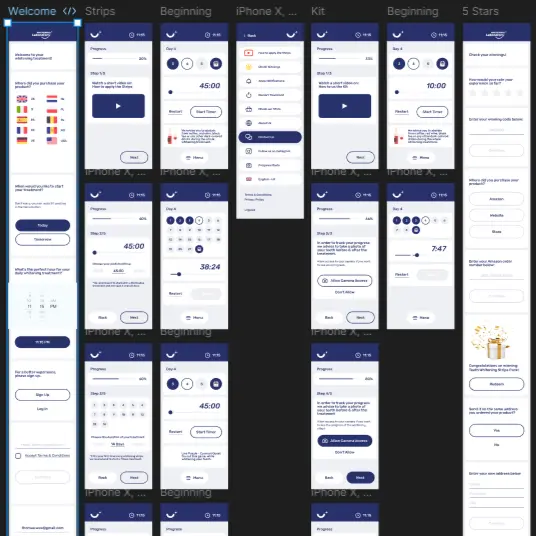
A teeth-whitening brand that ships strips and gel, then walks the customer through every session in a guided app. One product line, four connected surfaces: the treatment app, a direct-to-consumer store, an internal dashboard, and Amazon marketplace automations.
Услуги
Mobile App Development · E-Commerce Development · Amazon Automations · Internal Dashboard · UI/UX Design
Технологии
React Native · Nuxt.js · Node.js · Amazon SP-API
The product
The whitening kit is half the product. The app is the other half.
Whitening Laboratory sells take-home strips and gel. A box of either is easy to get wrong on your own: when to start, how long to leave it on, whether it's even working. So the brand ships a guided treatment app alongside the kit, and that app is where the customer actually lives during their course.
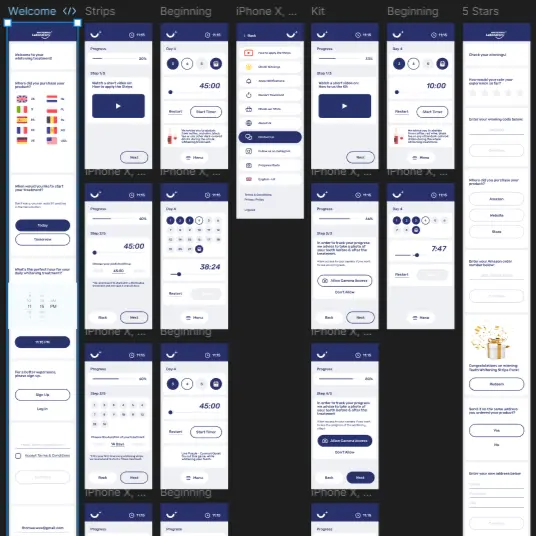
Onboarding is the on-ramp: pick your language, tell the app which treatment you bought, choose a start date. From there it's a day-by-day plan: a progress ring per session, a short how-to-apply video, and an on-screen timer that counts down the exact wear time for strips or gel. The customer follows along instead of guessing.
A built-in menu keeps everything one tap away: how to apply, restock, support, and a prompt to take a before-and-after photo so progress is something you can see, not just remember.
Three channels, one operation
Direct store, Amazon, and the dashboard that ties them together
The app sells the experience; the rest of the stack sells the kit and keeps the brand running. Three pieces, built to share data instead of fighting it:
- The direct-to-consumer store: built on Nuxt.js with server-side rendering, this is the brand's home address. It owns pricing, promotions, and the post-purchase relationship, with none of it filtered through a marketplace's conventions.
- Amazon, on autopilot: an integration with the Amazon Selling Partner API keeps listings, stock, and orders in sync both ways, so marketplace orders land in the same pipeline as direct ones and the team stays out of Seller Central.
- The internal dashboard: one operations view where direct and Amazon orders share a queue and inventory shows real numbers, not channel-specific guesses. Built for the people processing the next order, not for a board deck.
The thread running through all three is the reward-code flow: a code in the box unlocks perks in the app and asks where the kit was bought (Amazon or the website), closing the loop between a marketplace sale and a customer the brand can actually talk to.
Следующий кейс
ФАЙЛ 13